-
New at CBITs
-
Center for Behavioral Intervention Technologies (CBITs)
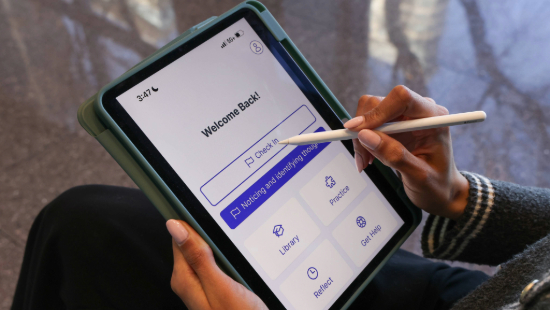
Inaugurated in September of 2011, the Northwestern University Center for Behavioral Intervention Technologies provides a unique home for research and education on Behavioral Intervention Technologies (BITs). BITs are applications that use technologies such as mobile phones, computers, tablets, and sensors to support behaviors that improve health, including mental health.
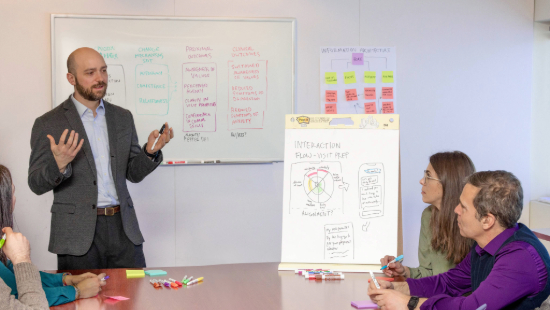
CBITs is made up of a multidisciplinary group of researchers working in the fields of Engineering, Computer Science, Psychology, Medicine, and Health Services. Although our approaches differ, we share this goal: to improve the understanding of BITs from design to evaluation and from implementation to dissemination. We are not just interested in how existing evidence-based health interventions can be enhanced by technology; we are invested in exploring how tomorrow’s technological advances can fundamentally change the way we understand and intervene in human behavior to improve health and well-being.
In addition to funded research by CBITs faculty, the Center also houses the BIT Development Core, a Feinberg School of Medicine Core Facility that supports researchers in the conceptualization, creation and deployment of BITs. Our in-house engineering team has created Purple, which is the foundation of our behavioral intervention technologies development program. Purple's authorship tools allow investigators to expediently create and manage behavioral interventions. Purple avoids the need to build behavioral technologies from scratch by storing development strategies, as well as researcher and client-side technologies, in a manner that can be re-purposed for new research projects.
-
People
The Center for Behavioral Intervention Technologies (CBITs) plays a central role in developing research on the application of technology for behavior change. Membership is open to all interested Northwestern faculty.
To apply, please send your CV to Lisette Luistro at m.lisetteluistro@northwestern.eduFaculty (alphabetical order)
Affiliated Investigators
Center Administration & Staff
Students & Post-Doctoral Fellows
-
Development Core
The BIT Development Core is a Feinberg School of Medicine Core Facility that supports researchers in the conceptualization, creation and deployment of BITs. Our team of technologists, psychologists, and health researchers can help you build and deploy web-based, mobile phone, tablet, and sensor-based behavioral interventions. This includes assisting in the early planning and design of the interventions, programming the interventions, and early alpha testing to ensure technical reliability.
- BIT Core Services include:
- Grant writing and grant consultation
- Development and deployment of behavioral intervention technologies (BITs)
- Development of technology assisted assessment tools
- Creation of secure data collection methods
- Support for usability testing
- Training and supervision for clinician/coaching protocols
Traditionally, "behavioral intervention technologies" (BITs) are merely technology-supported versions of face to face, evidence-based behavioral interventions. In many cases, existing approaches of envisioning, authoring, and deploying BITs do not effectively leverage the benefits of technology innovation for both the patient and the researcher. At CBITs, we are improving on and redefining this process by creating a BITs development architecture that is the brainchild of both researchers and technologists. Taking into consideration existing software development approaches, the use of human-focused design narratives, evidence-based intervention techniques, and the challenge of data needs in behavioral research, we are offering core development and implementation services to the research and healthcare communities.
Learn more about BIT development from our past presentations.
For more information on services available, please contact Jenna Duffecy, Ph.D. at 312-503-1900 or
j-duffecy@northwestern.edu. -
Presentations
Below are select CBITs presentations on the development of behavioral intervention technologies.
Purple Development Environment for Behavioral Intervention Technologies (BITs) informational session. In this section is the Prezi presentation from the session presented by Mark Begale and Jenna Duffecy, Ph.D.
Society of Behavioral Medicine 2012 Annual Meeting Workshop. In this section, you will find handouts and the Prezi presentation from our workshop at SBM's April 2012 conference.
Create Your Own Bit Checklist. A PDF guide to the early planning and design phases in creating technology-assisted interventions.
-
Research
PI
Institution
Funder
Title
Technology
Area
-
Funding
Pilot Grant
CBITs offers an anual pilot grant of $20,000 for the development of Behavioral Intervention Technologies (BITs) to Northwestern University faculty investigators. This grant program is aimed to catalyze BITs research within the Northwestern community.
The 2013 pilot grant RFA deadline was January 8th, 2013. Please check back this Fall for the 2014 RFA application information, instructions, and deadlines.
The 2013 Pilot Grant was awarded to Kelly Glazer Baron, Ph.D., investigating Development of a Cognitive Behavioral Therapy Smartphone Application for Insomnia. -
Positions
Assistant/Associate Professor in Technology-Assisted Behavioral Intervention
Department of Medicine, Division of General Internal Medicine, Northwestern University Feinberg School of Medicine
Postdoctoral Fellowship
Center for Behavioral Intervention Technologies, Northwestern University Feinberg School of Medicine
Web Applications/Software Developer Associate
Center for Behavioral Intervention Technologies, Northwestern University Feinberg School of Medicine
-
Assistant/Associate Professor in Technology-Assisted Behavioral Intervention
The Division of General Internal Medicine and Geriatrics and the Center for Behavioral Intervention Technologies (CBITs) at the Feinberg School of Medicine, Northwestern University seek an outstanding scientist, either PhD or MD, at the rank of Associate or Assistant Professor, full-time status, with an anticipated start date of Summer 2013. Established in 2011 under the direction of Dr. David Mohr, CBITs provides a unique scientific home for applied researchers who integrate behavioral science, information and communications technologies, and clinical intervention research. The successful candidate will have research interests in the development, evaluation, or dissemination of eHealth or mHealth interventions, with an emphasis on health behaviors such as diet, exercise, adherence to medications or medical regimens, and disease management. Expertise in the application of a number of intervention technologies is sought, including but not limited to mobile applications, web applications, sensor technologies, social networking, virtual reality, serious gaming, or integration of eHealth interventions into EMRs. Tenure status and salary are to be determined based on qualifications and experience. Northwestern University is an Affirmative Action/Equal Opportunity Employer. Women and ethnic minorities are encouraged to apply. Hiring is contingent upon eligibility to work in the United States.
Please send a letter explaining your career goals and a CV to David C. Mohr, Ph.D., c/o Lisette Luistro, Department of Preventive Medicine, 680 N. Lakeshore Drive, Suite 1400, Chicago IL 60611 or electronically to m.lisetteluistro@northwestern.edu. Please refer to Job ID: 17686.
‹ Positions -
Postdoctoral Fellowship
Center for Behavioral Intervention Technologies
Northwestern University's Center for Behavioral Intervention Technologies (CBITs) is searching for a postdoctoral fellow with strong interest and competency in the development and evaluation of e-health, m-health and technology-assisted intervention for depression, medical disease management, and/or other behavioral medicine treatment targets. The fellow will work on NIMH-funded trials of e-health and m-health interventions, which will include conducting telephone psychotherapy and supporting eHealth interventions. The fellow will have the use of data from completed trials for publications. The primary objective of this fellowship is to prepare the individual for an academically oriented career in clinical research. Minority applicants encouraged. Appointments begin July 2012 and are for one year, renewable to two, pending budgetary approval. Salary is competitive. Additional qualifications include Ph.D. in clinical psychology, evidence of scholarship, and excellent writing skills.
Please send CV, statement of research interests & goals, and three letters of recommendation to David C. Mohr, Ph.D., c/o Lisette Luistro, Department of Preventive Medicine, 680 N. Lakeshore Drive, Suite 1400, Chicago IL 60611 or electronically to m.lisetteluistro@northwestern.edu.
‹ Positions -
Web Applications/Software Developer Associate
Center for Behavioral Intervention Technologies
The Web Applications/Software Developer Associate will be responsible for supporting the existing infrastructure as well as develop new technologies in the area of internet and mobile phone mental health interventions within an academic medical center. The ideal candidate must display excellent written and oral skills with demonstrated interpersonal and organization abilities. A candidate for this position must be able to work in a varied, fast paced environment. Flexibility and tolerance is a necessity.
To apply, visit Northwestern University's Department of Human Resources and refer to Job ID: 17562.
‹ Positions -
Be a Participant
We rely on participants to test and provide feedback on programs and applications we develop. We are currently recruiting.

Interested in how new internet and mobile phone-based programs can promote health and wellness for teens? We are designing new internet programs and mobile phones apps to teach young people how to become more aware of their mood and what causes it to change. We are looking for teenagers who have internet access and an email account to participate in one to five focus interviews.
Learn more and participate!
User Testing
CBITs is currently evaluating the function and design of a number of mental health interventions and applications. These include mobile phone, social network and web based interventions that are aimed at addressing issues such as medication adherence, interpersonal skills training and establishing more streamlined and customized patient care systems.
If you are interested, please complete the survey located here.
New studies and opportunities to participate in CBITs research will be available over the coming months.
Please click here to enroll for future opportunities. -
Find Us
View Larger Map
Department of Preventive Medicine
Feinberg School of Medicine
Northwestern University
680 N. Lake Shore Drive, Suite 1400
Chicago, IL 60611
+1 312 503 3128
m.lisetteluistro@northwestern.eduContact Form
-
Context Sensing
Ubiquitous, everyday technology is increasingly being used to detect, understand, and monitor health behaviors. Researchers and developers at CBITs are employing emerging sensor technologies to design better health interventions. In the future, using data collected passively and continuously from patients and consumers, behavioral intervention technologies can be closely tailored to each patient, reaching out to patients at the right time and when it is needed most.
Several of our researchers are
investigating the use of mobile phone, wearable, and environmental sensors to collect data (e.g. WIFI, GPS,
Bluetooth, accelerometer) with the intention of identifying risk and resilience states and to support treatments.
Current projects include those aimed at improving the lives of people with depression and bipolar disorder. We are
also developing assistive technology for older adults, as well as for individuals with various physical and mental
disabilities. We do this by creating personal mobile assistant tools based on mobile sensors, and in-home
monitoring technologies based on ambient and wearable sensors.Featured Projects:
-
Medication Management
Advances in medicine have brought more effective treatments for a wide variety of health conditions. However, one of the main obstacles to effective medical care is the failure of patients to take medications as instructed. Behavioral intervention technologies (BITs) have the potential to create support tools that can go beyond simple reminder systems. Future medication adherence BITs will know as soon as a dose is missed and can tailor encouragements based on how the patient is feeling or if side effects are experienced. Also, BITs can enable effective communication between the individual and the health care team regarding response to treatment and can help determine if more in-depth medication counseling is indicated.
At CBITs we are exploring the use of smartphones to improve medication adherence. We are designing medication management tools that use mobile phones to communicate wirelessly with pill holders and medical records. Our current projects include medication management systems for patients with HIV/AIDs, depression, hypertension, and schizophrenia.
Featured projects:
-
Mobile Interventions
Mobile technologies are increasingly ubiquitous and growing in sophistication. These technologies hold great promise, as they extend treatment from therapy rooms, doctor's offices, and hospitals into patient's daily lives and routines. Along with this change is the urgent need to adapt intervention designs to the medium of mobile technologies and establish efficacy and effectiveness in these real-world settings.
Much of our research is focused on improving the design and delivery and incorporating technologies to optimize adherence and outcomes across diverse populations. CBITs is currently supporting a number of interventions that makes use of today's smartphone technology and building interventions that develop the use of tomorrow's smartphone technology. These interventions deliver therapy, education, and health interventions to patients "in-the-moment" using technologies they carry with them in their everyday lives.
Featured projects:
-
Web Based Interventions
We are examining how supportive accountability and collaborative learning can enhance adherence to web-based interventions, as well as how web-based interventions can be integrated into standard methods of psychological and behavioral care.
We are developing and evaluating how web-based interventions can help a wide variety of patients such as prostate cancer survivors, kidney transplant recipients, and primary care patients with depression. We are also developing a peer network based intervention program that aims to prevent depression in teenagers by teaching coping and mood management skills.
Featured projects:
- Interested in participating in a research study? Click here to sign up.
- We are looking for new tenure & non-tenure line faculty. Please go here for more information.
- View our checklist for creating your own BIT or contact us for assistance.
- 1
Context Sensing
Tailoring behavioral interventions to each patient's life context.
- 2
Medication Management
Improving medication adherence through mobile smartphone interventions.
- 3
Mobile Interventions
Behavioral interventions anywhere, everywhere.
- 4
Web Based Interventions
Developing the next generation of eHealth interventions.
- 5
Build a BIT
Have us built a behavioral intervention technology for you.